Indigenous Development Alternatives: Social Justice, Resource Rights, Institutional Hybridity
Indigenous Development: Social Justice, Resource Rights, Institutional Hybridity is a research project that focuses on the intersections between social justice, resource rights and institutional hybridity on land to which indigenous peoples have rights and/or exclusive title in Australia. We reconceptualize notions of development, recognizing variation and hybridity and shifts away from the hegemonic western constellation of discourses to examine local institutions and the hybrid western/customary forms that they must take where indigenous political geography and identity remain dominant.
This project takes place in north Australia, from Kakadu National Park to the west to the lands of the Yolngu to the east. Most of this area was gazetted the Arnhem Land Aboriginal Reserve by the colonial state and then was converted without a land claims process to Aboriginal ownership (inalienable freehold title) under land rights law from 1976. The indigenous population of the region is about 18,000. This area of 120,000 sq kms is covered by tropical savannah, escarpment and high biodiversity flood plain. Four Indigenous Protected Areas—Warddeken, Djelk, Dhimurru and Yirralka—were declared in Arnhem Land for world-class environmental values. Additionally, Kakadu National Park has World Heritage listing for its cultural and environmental values.
Indigenous people in this region experience deep poverty. There are two major operating mines at Jabiru (within Kakadu National Park) and at Gove (both owned today by Rio Tinto) that provide employment opportunity, though the
Bininj in the west and the Yolngu in the east are often reluctant to take up this employment. Mining agreement payments have totaled tens of millions of dollars since the 1970s.
This is a region where the state looms large—not in terms of day-to-day governance because communities are sparsely populated and dispersed—but through transfer payments, limited service entitlements, and considerable welfare to individuals and families. High dependence, poverty and a degree of political disengagement make the regional population highly susceptible to state policies and unilateral shifts.
Since the 2007 Northern Territory Emergency Response (NTER) Intervention, a neoliberal consensus has pushed indigenous people to “join the mainstream” and adopt western norms to close statistical gaps. In the postcolonial period, livelihoods were hybrid: state subsidy, some market engagement, and a non-market customary sector. This hybridity was underwritten by the state—especially via the community-controlled Community Development Employment Projects (CDEP) scheme—and robust resource organisations. Funding for rangers under the Commonwealth Working on Country program has provided employment in Indigenous Protected Areas. This raises key issues within
Livelihoods & Food Sovereignty,
as existing forms of postcolonial livelihood have eroded.
There are also real threats to regional biodiversity from climate change, feral animals, and exotic weeds which, alongside a decline in on-country living, increase dependence on store-bought foods over bush foods.
Key questions that link with other CICADA themes include:
How can neoliberal ideology trump evidence that, in this remote region, economic hybridity rather than imagined market capitalism delivers more productive livelihoods?
How can challenges to regional biodiversity be ameliorated so that food security based on production for domestic use can be revived?
What are local notions of the good life, and how do people view policy unilateralism that has eroded limited autonomy and work organisation that once meshed indigenous priorities with external engagement?
The central practical question is how communities can be empowered to influence the form of their livelihoods amid state domination and an enduring commitment to late capitalism. Additionally, communities are assessing how their comparative advantage in natural and cultural resource management can be fully realized to reduce negative impacts on ancestral lands and resources that historically supported a degree of food security.
Conceptual and Methodological Connections within CICADA
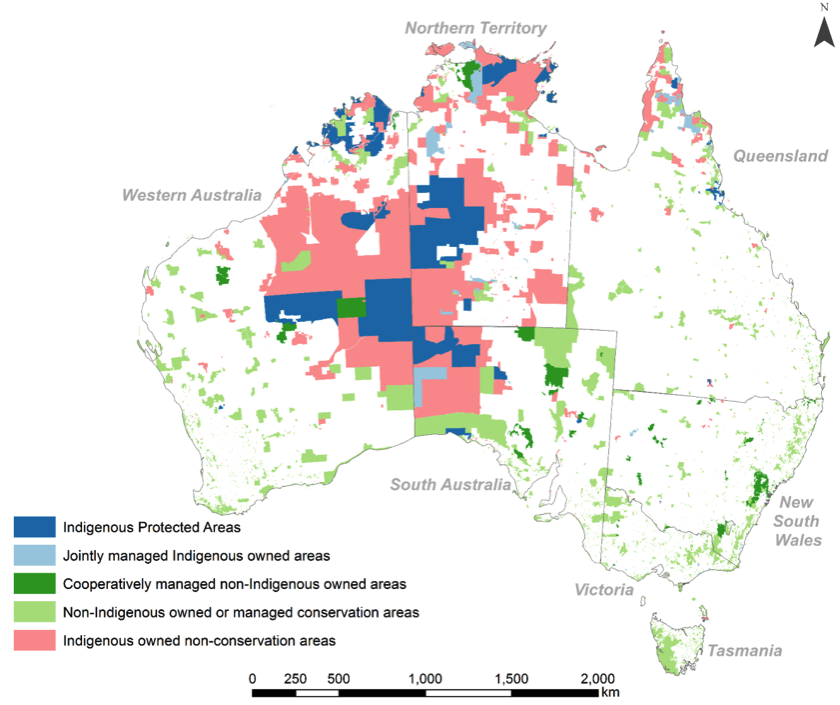
Map 1. Indigenous owned and conservation lands in Australia. Source: Jon Altman.
Starting with the land base, almost all of the region of interest is under Aboriginal statutory title and also recognised in subsequent native title law. A statutory land council—the Northern Land Council—has legal obligations to ensure free, prior and informed consent (FPIC) of traditional owners before any third-party commercial development. FPIC provisions in the Aboriginal Land Rights Act give traditional owners de facto mineral rights (exploration can be vetoed) and rights over resources for customary use; along the coastline, customary rights can combine with commercial rights.
A combination of statutory and customary rights has enabled declaration of significant Indigenous Protected Areas (about 40% of the region), with nearly 20% declared as national park. Declarations required many traditional owner groups to join lands into environmental commons managed by community-based ranger groups—work that aligns with life projects centered on protecting country from wildfire, feral animals (cats, pigs, buffalo), exotic weeds and marine pollution.
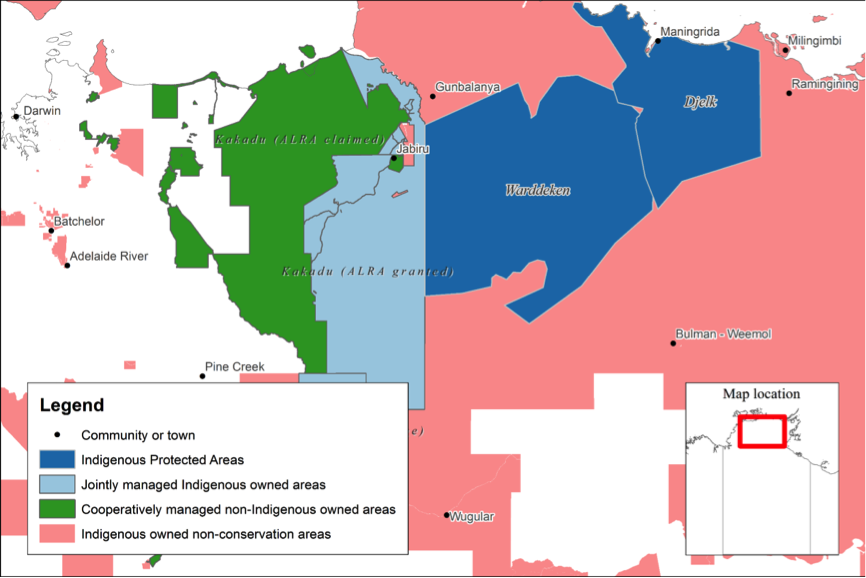
Map 2. Indigenous owned and conservation lands in western Arnhem Land. Source: Jon Altman.
This project explores governmental, institutional and endogenous barriers to these visions. A tenure map of Australia shows the region of interest in the north of the Northern Territory, followed by a larger-scale map of Kakadu and west Arnhem (see Maps 1 & 2). With indigenous partners, we use this statistical picturing to advocate for the conservation possibilities of relatively intact ancestral lands.